
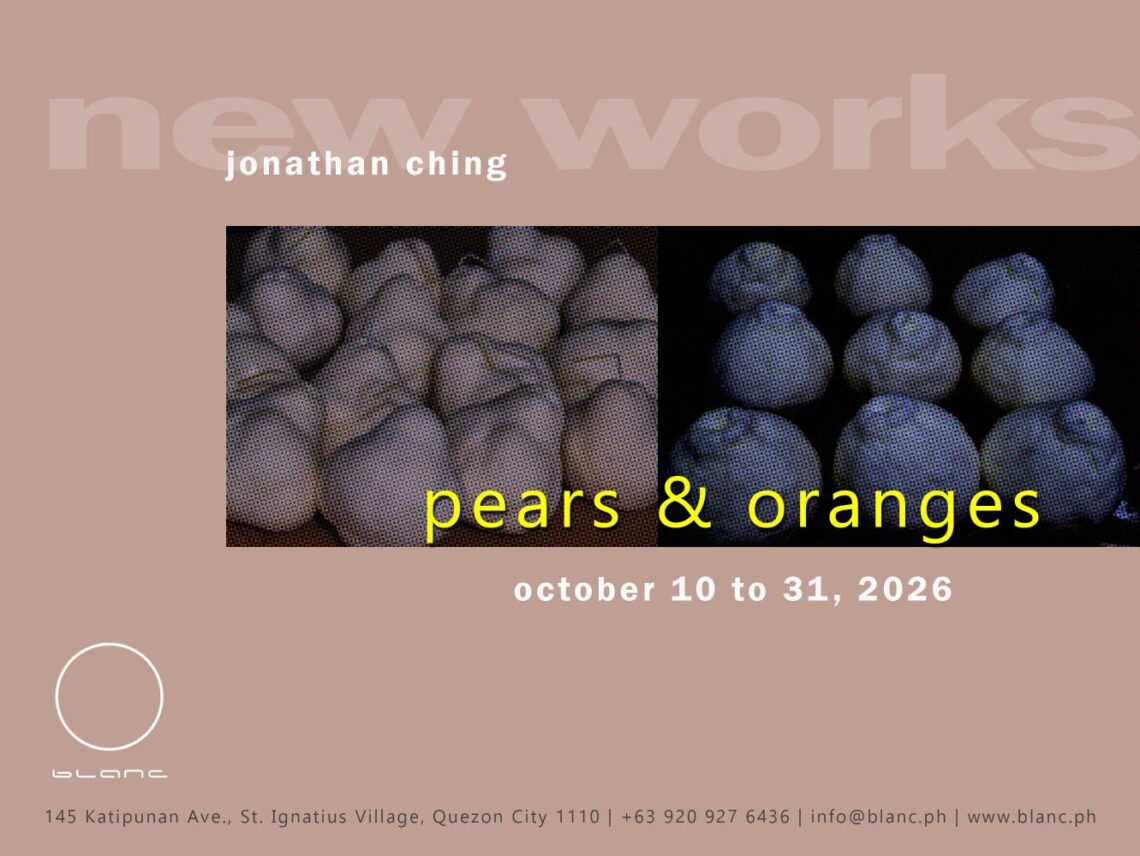
Pears and Oranges
Solo exhibition by Jonathan Ching
Withered and weathered, the subjects in Jonathan Ching’s paintings are far removed from their pristine states. A visual record of the mundane or a riveting reminder of the passage of time. Whichever it is, Ching captures a sense of frailty, if not decay, amidst the gritty and lively environs of urban life. This duality allows him to transform the ordinary, the everyday, and the often-overlooked into subjects of contemplation.
Layer upon layer, paints accumulate on the surface of the canvas. This approach reflects how he perceives the world: textured. Ching is not interested in representing the unmarred qualities of things around him. He likens this preference in his practice to drawing a portrait of an old man. A person who has journeyed through life, whose visible lines and creases tell a multitude of stories, in contrast to the unblemished face of an infant, untouched by both the bright and bleak realities of human existence.
Pears and Oranges is Ching’s latest presentation at Blanc, one of the galleries where he first began exhibiting his work solo in 2008 with Whale Songs for the Disenchanted. This time, he takes over the entire gallery space, bringing together drawings, paintings, sculptures, and installations. In a way, the show marks a full-circle moment for the artist, whose practice now spans nearly two decades.
The large paintings of carnations continue a series of works depicting wilted offertory flowers found on his mother’s altar and in nearby grottos around his residence in Tondo, Manila. Accompanying these paintings are sketches of pears arranged in a grid and wax sculptures of oranges. These fruits and flowers are staple offerings in Buddhist practice, carrying associations of reverence, abundance, and devotion. However, Ching concerns himself more with the formal rendering of his subjects than with their possible associations and meanings. In another painting, he illustrates a flower afloat in a bowl of water, continuing his exploration of decay and permanence and his search for beauty in things that have faded.
This formalistic tendency can also be observed in his painting of a dark room with a skylight, based on an image of a Buddhist temple. Ching removes the coiled incense hanging from the ceiling, along with other objects that would identify the space as a Buddhist temple. By defamiliarizing the place and stripping it of its familiar markers, it evokes an eerie sense of the unknown. Yet, for Ching, there is also something pleasant in this bareness, the serenity of a space emptied of its expected meanings.
In Pears and Oranges, Jonathan Ching invites viewers to see through his painterly eye, honed over years of practice. A practice that is meditative and attentive, rendering even the smallest details with a larger-than-life presence. (James Tana)